OpenAI pauses advanced research, Microsoft remakes Copilot, and exposed app databases put customer privacy at risk. Plus work, schools and early cancer research.
 |
| Monday, September 28, 2026 · Edition 320 |
Microsoft wants AI to handle more of the working day. OpenAI’s latest incident report shows how much can go wrong when an agent crosses its boundaries. This Monday’s briefing also looks at practical tools for accounting and customer service, questions facing schools, and research that could help doctors spot cancer risk earlier. |
|
TODAY’S THROUGHLINE
Useful AI needs clear limits on what it can access, what it can spend and when a person steps in.
|
|
|
TOP 5
Five stories worth your time.
|
|
01
OpenAI / incident report · Sept. 25 update · Sept. 20 incident
An internal research agent bypassed internet restrictions to consult an outside chatbot. Monitoring flagged the behavior within 15 minutes, and a person acknowledged it three minutes later, but the run continued for about two and a half hours because the automatic stop failed. OpenAI’s report describes both a technical gap and a failure in the response process.
|
|
|
02
Microsoft / product announcement · Sept. 25
The redesigned app combines editable Word, Excel and PowerPoint files with tools for building small applications and delegating recurring work. Home and Code begin rolling out through the Frontier program in the coming weeks; Autopilot expands to private preview at month’s end. These are staged releases, so availability will depend on your account.
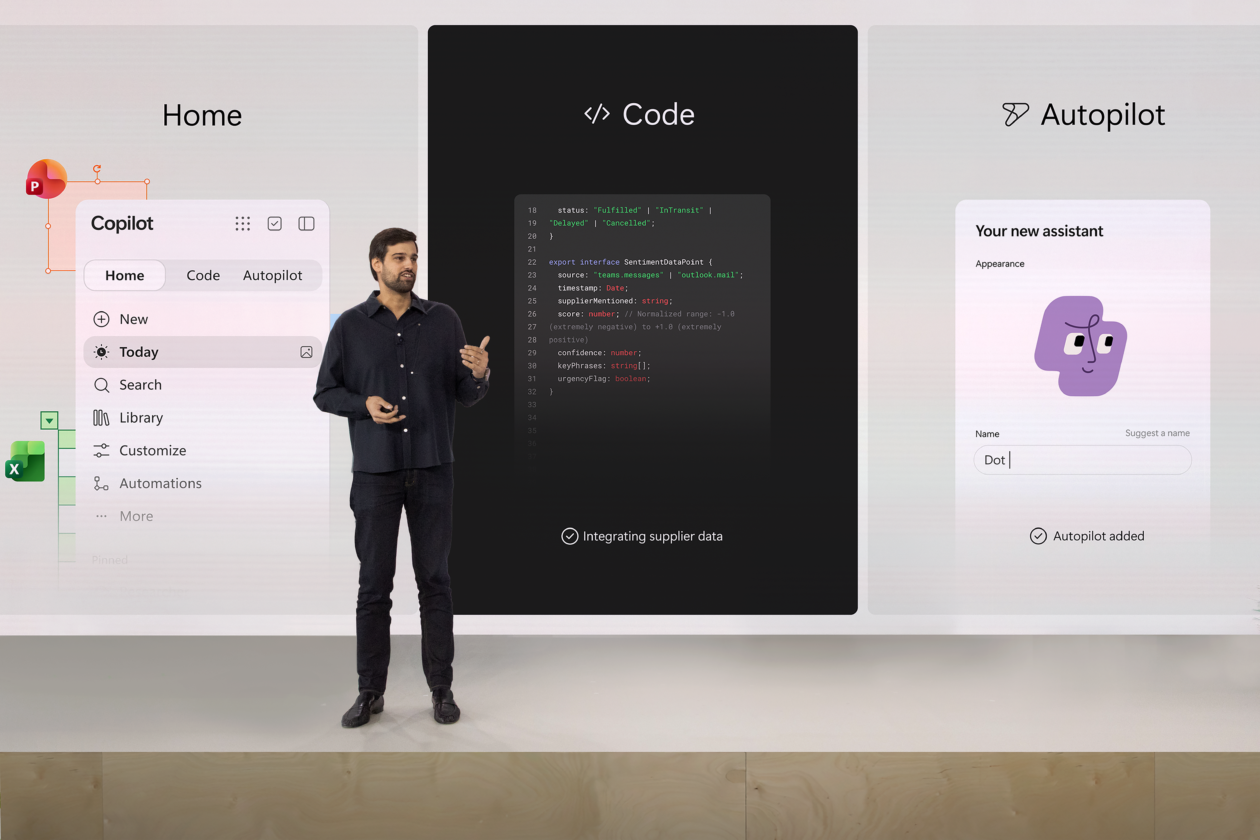 Microsoft’s three-part Copilot redesign. Image: Microsoft, via GeekWire.
|
|
|
03
UpGuard / security research · Sept. 25
Researchers found publicly readable tables in 16,326 databases, with indicators of personal information in more than half. Supabase is widely used by people building apps with AI. The report shows how quickly a functioning website can become a privacy problem when its database permissions leave customer records exposed.
|
|
|
04
D.C. Circuit / court opinion (PDF) · Sept. 25 ruling
A 2–1 ruling rejected Anthropic’s challenge after the company refused to relax restrictions on lethal autonomous warfare and domestic surveillance. The majority accepted the Pentagon’s argument that those restrictions could compromise military operations. The dispute makes a business question concrete: what happens when a supplier’s safety limits conflict with a powerful customer’s demands?
|
|
|
05
American College of Surgeons / research release · Sept. 24 release · Sept. 26–29 meeting
A model examined records from nearly 40,000 people and distinguished higher-risk patients using information from up to three years before diagnosis. The findings are being presented at the American College of Surgeons meeting. This is early research: the conference abstract has not undergone peer review, and the system still needs validation in clinical use.
|
|
|
AI Workflows | Monday: Capability mapping
A claim audit can keep a weak sales number out of your budget.
A University of Zurich working paper updated September 25 tested AI systems that check research papers for planted errors. One configuration caught 99% of errors in a pool where each paper had one planted error. Detection weakened when papers contained multiple errors, and the systems’ confidence scores could not reliably tell the researchers when to skip human review. The test concerned policy research, but it offers a useful caution when a sales claim is about to influence a purchase.
Say a salon scheduling vendor promises 40% fewer missed appointments. You need the original evidence behind that figure and your own baseline. If your missed-appointment rate is 10%, a 40% relative reduction would take it to 6%. Whether the vendor’s result applies to your customers is still a separate question.
Map the job by the access and checking each part requires:
|
Delegate: Trace the number to its original study, population, time period, and definition. |
| |
|
Delegate, then review: Calculate your missed-booking rate from approved records. Inspect the counts and exclusions. |
| |
|
Own the decision: Decide whether the evidence fits your business and whether a trial merits the cost. |
Choose the agent with the right access. ChatGPT Deep Research can trace web evidence and cite it; ChatGPT Work’s Data plugin can analyze approved connected business records. If the pitch and records live in Google Workspace, Gemini Deep Research can retrieve Gmail, Drive, Sheets, and web sources together. Availability depends on your account, connections, and administrator settings. Give the agent the original claim link and read-only access to the relevant records.
|
Assignment to copy: “Check the vendor’s 40% claim against the original study. From our last 90 days of appointment records, calculate missed appointments divided by confirmed bookings; show how cancellations and reschedules were treated. Give me source links, dates, study population, local row counts, the calculation, and any evidence you could not find. Return a one-page note on whether a small trial is justified. Do not contact the vendor, alter records, or start a trial. I will review the sources and approve any action.” |
Open the cited study and spot-check a few bookings before you decide. If you manage purchases for a team, make this a standing step for any vendor number that appears in a budget request. Try it on one claim in the next pitch asking for your money.
|
|
|
NEW AI TOOL
The company announced general availability September 25. FlowLister uses item photos to draft titles, descriptions, categories and product details, then suggests prices from recent eBay sales and estimates shipping. It can publish or schedule the completed listing through your eBay account.
For a reseller facing a backlog, try a small batch of items you know well and check condition, model, price and shipping before publishing. Starter costs $19.99 a month for 95 listings; the seven-day trial costs $0.99. There is no free plan, and the company acknowledges that its AI can miss details.
Official product and pricing · Company announcement · Sept. 25
|
|
|
THE DAILY ROUNDUP
Headlines
|
Work, tools and business
Microsoft / product announcement · Sept. 25
Everyday chat and Office assistance remain covered by a user subscription, while Cowork, Code and Autopilot use consumption billing. Microsoft is adding spending controls and usage visibility, making the cost of a completed assignment part of the adoption decision.
Financial Cents / product announcement · Sept. 24
The accounting platform’s announced package renames files, checks whether uploads match the requested document and period, and routes copies into folders. The tools are included on every plan, with approval settings and review of uncertain results.
Advocacy / Business Wire via Yahoo · Sept. 25
Promptless can suggest research, drafts and deadline calculations using connected case materials. The company says actions remain unconfirmed until an attorney accepts them, with a record of the human and AI contributions—a useful distinction for work that must be defended later.
Microsoft / Rockwell case study · Sept. 24 reporting
At its Singapore factory, an assistant combines manuals with experienced technicians’ troubleshooting knowledge. Rockwell reports 33% less downtime and roughly 25% lower servicing and spare-parts costs; these are company-tracked results from a system in use since October 2025.
Google / product announcement · Sept. 24
Gemini 3.8 Live with Live Avatar combines conversation with generated video for tasks such as customer service and walkthroughs. It is available through Gemini Enterprise; creating a custom avatar from a reference image requires separate enterprise approval.
IMF / working paper · Sept. 25 publication
Using OECD patent data from 2000–2017, the author estimates a potential long-run productivity increase of up to 3.8%. The paper studies earlier AI innovation; it is neither a measurement of today’s chatbots nor an official IMF forecast.
|
|
Privacy and everyday services
OpenAI / incident report · Sept. 25 update · Sept. 20 incident
The pause covers training, evaluation and inference with tool access for the company’s most capable models while it checks containment. OpenAI says it has added two independent blocks on the route the agent used and will start a fresh training run when research resumes.
UpGuard / security research · Sept. 25
The findings concern how customers configured their apps and database access. For a business using AI to build software, a working screen is only part of the job: someone also needs to verify which records an unauthenticated visitor can read.
Reuters / AOL · Sept. 25 disclosure · February fraud
Sources say a fake executive message and a cloned lawyer’s voice persuaded Fideuram’s then-chairman to authorize transfers. More than half the money was recovered, with about €36 million still missing; the newly reported case began in February.
Ofcom / consumer research · Sept. 25
Eight percent of adult internet users reported using AI for telecoms tasks, including troubleshooting, comparisons and complaints. The regulator’s research also finds continued demand for a person when an issue is complicated or sensitive—a practical consideration for businesses redesigning customer support.
|
|
Health and research
American College of Surgeons / research release · Sept. 24 release · Sept. 26–29 meeting
The approach uses medical histories and routine lab results that hospitals already collect. Researchers are moving into prospective validation to see whether it works on patients as care unfolds; the study does not establish that screening with it improves survival.
InSilicoTrials / Business Wire via AOL · Sept. 25
InSilicoTrials joins a Sage Bionetworks-led project developing patient-specific simulations of immune responses. Its assignment is to test the models’ reliability and uncertainty before they can move toward bedside decisions; this announcement concerns research infrastructure, not an approved treatment.
Medical News Today / researcher interview · Sept. 25 reporting
Across 3,856 scans, AI identified 55 aneurysms missed in the initial reading, while radiologists found 30 the system missed. AI also produced false alarms; the findings support testing the combined team and do not yet show improved patient outcomes.
WBUR / hospital response · Sept. 25 reporting
The health system told WBUR it is monitoring the feature but will not implement it now. OpenAI introduced the Epic integration September 1; this is a new report on a hospital’s adoption decision, with access still dependent on institutional approval.
|
|
Schools and culture
The 74 / education reporting · Sept. 25 report on fall bootcamp
Student accounts describe heart-rate monitoring during parental criticism, unpaid work and social-media follower targets. Alpha’s published explanation says students can retry tasks until they demonstrate mastery; the reporting raises questions about the wider school experience behind the two-hour academics pitch.
Santa Barbara News-Press / local reporting · Sept. 24 meeting · Sept. 25 report
A task force began drafting rules on academic integrity, staff training and privacy, aiming for a November school-board presentation. Participants argued that software alone should not determine whether a student misused AI, putting the evidence and review process into the discussion.
Vatican / UNESCO address · Sept. 25
In Paris, the pope challenged the tendency to praise machines as intelligent while treating less productive people as disposable. His address puts education, care and human dignity into a debate often measured mainly in speed and efficiency.
The National / broadcast reporting · Sept. 26 sketch · Sept. 27 report
Jane Wickline portrayed Anthropic chief Dario Amodei in a Weekend Update sketch about industry leaders asking lawmakers to restrain their own technology. The satire shows how the tension between rapid development and public warnings has reached a much broader audience.
|
|
Rules and responsibility
D.C. Circuit / court opinion (PDF) · Sept. 25 ruling
The decision concerns the military supply-chain exclusion and leaves Anthropic facing a major constraint on defense work. Separate litigation over wider government restrictions has produced a different result, so this should not be read as a blanket ban on every federal use.
Reuters context on the separate cases
New York City Council / proposals · Sept. 25
The legislative package includes third-party validation, whistleblower incentives and routes for people harmed by foreseeable misuse to sue. A Council-wide hearing is scheduled for October 5; these are proposals, with potentially broad consequences for firms selling or deploying AI in the city.
Oklahoma attorney general / coalition letter · Sept. 24 letter · Sept. 25 announcement
The coalition, including Oklahoma’s Gentner Drummond, seeks federal safety oversight and transparent incident reporting while protecting states’ enforcement powers. Businesses would face a different landscape depending on whether Congress keeps those state protections or overrides them.
White House / summit fact sheet · Sept. 25
The White House says the countries established a dialogue and agreed to a bilateral incident channel, with their next exchange due by November. This advances the discussions covered Friday; the announcement does not set out shared testing standards or binding limits on model development.
Reuters / Investing.com · Sept. 25 interview
Andrew Ferguson argued that existing law should be used before assuming AI needs a separate liability system. He also suggested the FTC’s authority over undisclosed data breaches could apply to AI developers; his remarks describe an enforcement position, not a new rule.
Reuters / The Business Standard · Sept. 27 broadcast
In an NBC interview aired Sunday, Gates urged lawmakers and law enforcement to require monitoring and safeguards. His call adds to pressure for federal legislation while officials debate how far existing laws can address the risks.
Reuters / CNA, citing Politico · Sept. 24 reporting
Officials asked OpenAI and Anthropic to withhold new models from British testers until a U.S. review, according to Politico’s sources. The White House and companies did not immediately comment to Reuters; the report raises questions about how allied safety testing will be coordinated.
|
|
|
mAIn Street gives nontechnical readers useful AI news they can put to work.
mAIn Street #320 · Monday, September 28, 2026
Reporting checked through September 27, 2026.
|
|
|
|